
Starfleet Academy Review: Series Acclimation Mil
Updated: Aug 8
Spoilers below
I've talked before about my awareness that ultimately, this is a show that isn't really aimed at me. This is, as I've also said, good and necessary, but it also can make it hard to know what exactly to say about what I'm watching. It feels like going to see a Puccini opera without speaking Italian - I'm sure I'd take plenty away from the experience, but there'd always be the awareness that I'm not one of the people being sung to.
"Series Acclimation Mil" almost wholly inverts this. There are scattered moments of youth youthing away - the weird hash challenge, the trip to The Academy - but this is clearly first and foremost a story about how the past of Trek can inform and enhance its present.
This is, quite clearly, an idea I am wholly here for. Not just as a general principle, either. 've been complaining since the first episode of Picard that the franchise has seemed determine to deep six Deep Space Nine, to its obvious detriment. Returning to the story of Benjamin Lafayette Sisko, and his son Jake, is a delight impossible to explain to someone who doesn't have it scratched into their souls in the same way I have.
But this isn't supposed to be for me. It's impossible for me to guess how newcomers to the franchise will take all this (though I'm sure other reviews will make this clear soon enough). It's been twenty-seven years since "All That You Can't Leave Behind". As best as I can tell, Karim Diane is the only cast member playing a cadet who was even born when Sisko joined the prophets. I'm left with an episode that made my heart sing, but which I can't possibly judge in the context of the show it belongs to.
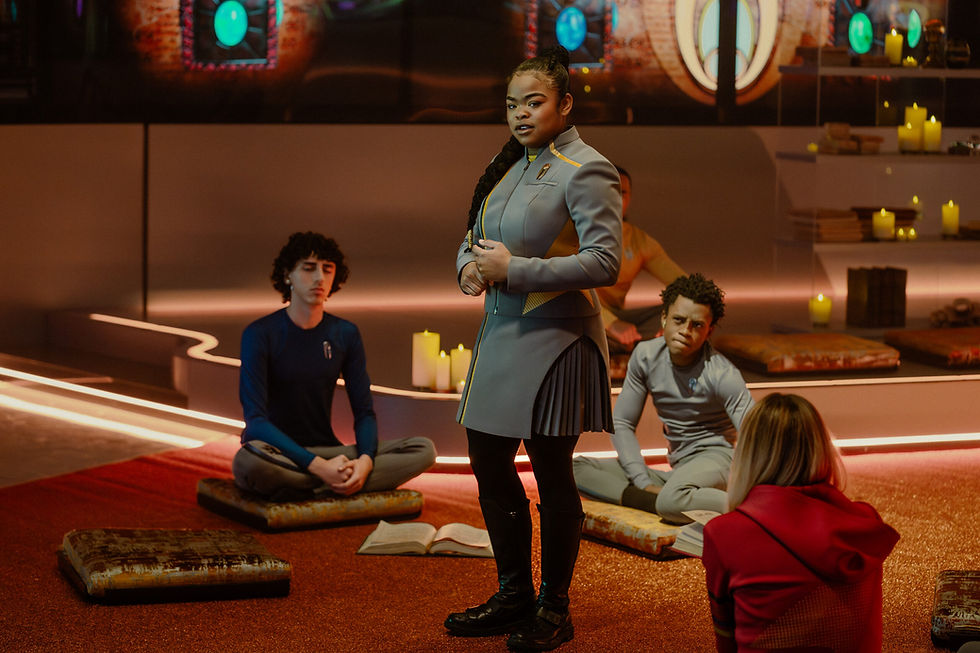
Still, I'll try my best. It's notable that "Series Acclimation Mil" works very hard to make it clear that this fundamentally Sam's story. What little background newcomers need is run through quickly and efficiently (and, as standard for exposition on this show, with plenty of humor - "Bajoran kids don't play around"). With that done, the goal is to show how Sam identifies with the Siskos. Their tales are here to strengthen hers, not the other way round. This is further helped by how savvily the parallels are considered and drawn out. The relevance of the story of the Emissary to her own as Kasq's (seemingly) only off-world ambassador is clear and well-handled, and only grows deeper when Sam learns that Sisko, like herself, was literally created for the role they've taken on.
For all that, though, it's the connections she makes with Jake that make the story truly special. Like Jake, Sam is struggling with the fact those who gave life to her exist on a plane she cannot truly comprehend. I again can't possibly separate my opinions about the effectiveness of Cirroc Lofton's role in this episode from how delightful it is to see an adult Jake ruminating on how his father never truly left him, but seeing him recognise a kindred spirit in Sam and teach her how to hold her own against what might as well be gods feels perfectly in keeping with what this show wants to be. And crucially, he's not just explaining to Sam how Ben dealt with the Prophets, but how he dealt with Ben.
It would be easy to go down that rabbit hole, in fact, but again: this is about Sam, not the Siskos. Or rather, the latter should only be considered in this context - in this review - in terms of the former. At heart, what we have here is an extremely traditional Trek idea: you can't learn what it's like to be someone else by learning facts about them. We've been doing that dance since, at the absolute latest, 1986. A more dismissive read on the episode than I'm building might call this cliche. Humdrum. Run-of-the-Mil.
The familiarity of the basic structure isn't really what's important, though; it's what is built atop it. Sam isn't just one more iteration of Data. Her approach in trying to learn through information makes perfect sense in the context of someone trying to make their way through school, especially given her parent-analogues keep calling from home to effectively demand she justifies her module choices and grades to them. To the authorities on (in?) Kasq, Sam is in San Francisco to acquire information. Anything beyond that - making friends, engaging in recreational opportunities, learning who she is herself - is irrelevant. No-one with pushy parents is going to miss the metaphor here.
But there's more here too. The idea that we can't reduce the world to facts, and that we must be comfortable with ambiguity and subjectivity, isn't just a lesson for Sam to learn, but us. I mean "us" in the most general way possible here, but I also mean it in the sense of people like me, long term Trek fans watching its newest show take flight, sixty years after the world first learned the name James Kirk. We don't need to know what actually and specifically became of Sisko. It isn't a mystery to be solved. It isn't a fact to covert to fill some hole in our internal data files. He did come back. He didn't come back. He never even left. What matters is what Jake believes, and remembers, and loves. What matters is what Illa Dax believes, and remembers, and loves. What matters is what we believe, and remember, and love.
Starfleet Academy is, gleefully but amicably like Ake does Kelrec, tweaking the nose of every fool out there on the internet insisting the show sucks because it's suggested Jem'Hadar can reproduce, and be women, or that the show doesn't care about franchise history because one of the cadets looks to be Cheronite, despite Cheron being reduced to rubble with only two male survivors. It's telling those people that they're wholly missing the point. You might get the answers you seek if you hang around long enough, but those answers are never going to be what matters. The show is telling you it wants to believe in the same things you do, and to remember them, and to love them. It just needs you to recognise that all those things matter more than micro-level canon.
Speaking of Ake and Kelrec, I haven't even gotten to the Apherati B-plot. This, of course, parallels Sam's through its consideration of diplomatic engagement with people we find profoundly difficult to understand. At least, I think that's the intent. This is actually the first SFA episode in which I found the faculty's story to be the clearly weaker. Mostly, though, I think that's an editing issue - in particular, it wasn't actually clear to me how much of the soup ceremony was real, and to what extent the whole thing was a prank set up by Ake. Maybe it was clearer one way or another to others, but for me the question mark there really sunk the storyline. Still, even with that said, the whole thing was characteristically charming and repeatedly funny. Even this show's failures are done with flair. And since we're talking about the faculty, I can't end this review without briefly noting the Doctor's scene with Sam. I've been surprised the two don't interact more in general, and specifically in this episode, but the little we do get is sublime, as Picardo packs into just two sentences the accumulated pain of eight hundred years of loss.
Perhaps this is why he doesn't spend more time with Sam, actually; she's just so, so young. to the extent it hurts to think about how much loss she still has ahead of her. That there's so much she will have to learn to leave behind.
But then, the feeling of loss is, in its own way, a reflection of joy. We hurt over what is gone because of how lucky we were to have it when it was there, and how lucky we are that what was lives on in what we are. As the episode ends and the Deep Space Nine theme plays perhaps one final time, the past and present are one as surely as they are for the Prophets themselves. And I believe. And I remember. And I love.
Thanks, Avery.
Ordering
1. Series Acclimation Mil 2. Kids These Days 3. Vox In Excelso 4. Beta Test 5. Vitus Reflux


Comments